
Weird, wounded, and wonderful
This 49ers team is the most flawed of all their playoff teams—and the most inspiring.

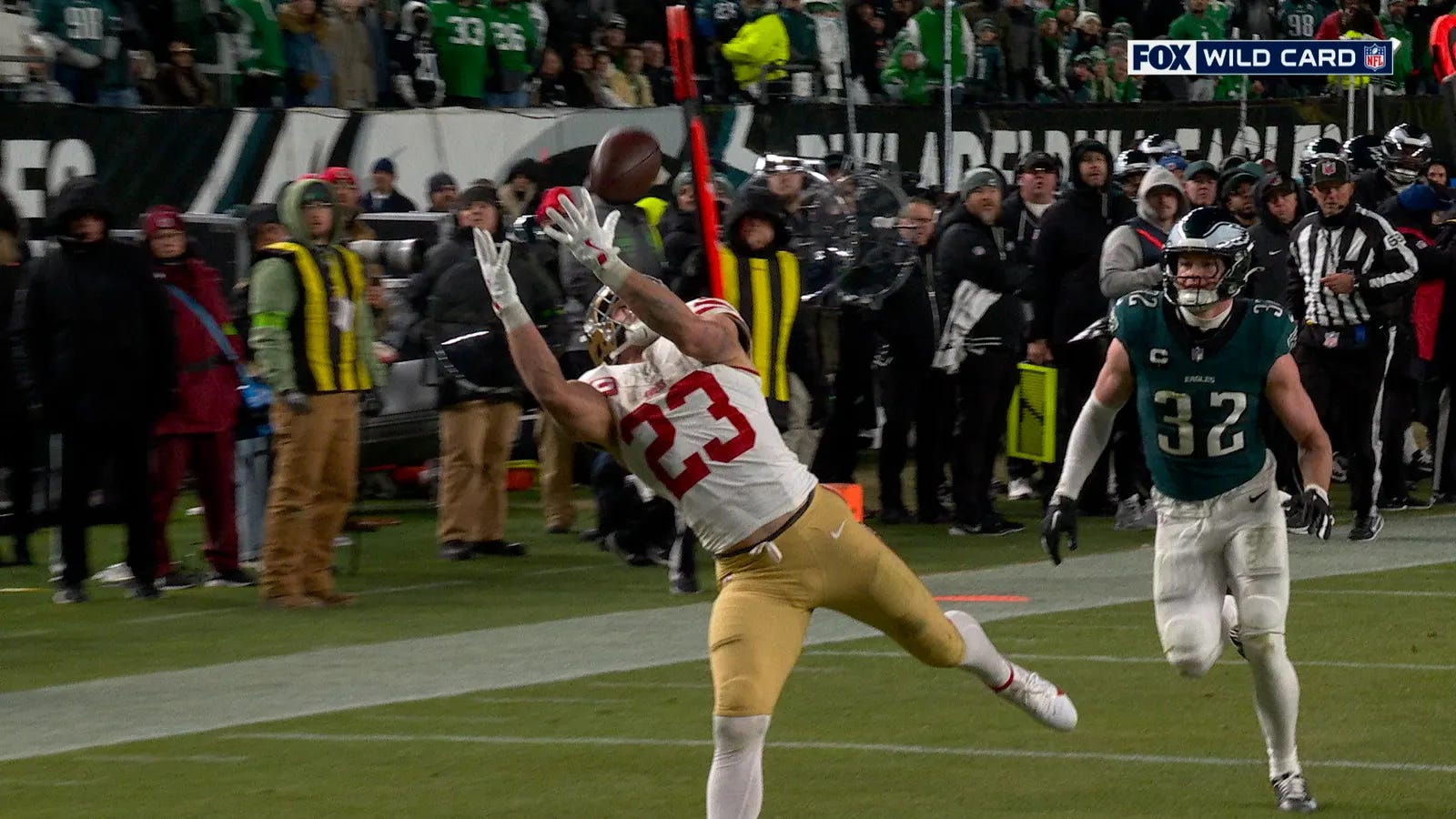
49ers running back Christian McCaffrey makes an over-the-head touchdown catch in his underdog team’s playoff victory over the defending champion Philadelphia Eagles.
The 49ers went into Sunday’s wild-card playoff game against the defending Super Bowl champion Philadelphia Eagles starting two linebackers who were not even on the team five weeks ago. One of them, the unfortunately-named Garret Wallow, was a virtually unknown 26-year-old journeyman who had played for three other NFL teams in his career, starting just five games. Wallow was waived by the Denver Broncos on Dec. 6 and picked up by the 49ers on Dec. 8. The other, Eric Kendricks, was a decorated vet who had an outstanding career with the Minnesota Vikings, San Diego Chargers and Dallas Cowboys, but at almost 34 was one of the oldest linebackers in the league. Kendricks had offseason shoulder surgery, had been released by the Cowboys and was spending a lot of time on his couch while rehabbing, watching games on TV and wondering which team he might want to play for. When the 49ers called, he chose them because he had been impressed by the way they responded to one catastrophic injury after the next. “I was so excited for this opportunity because I watched everybody step up and how the team responded to that,” Kendricks told The Athletic’s Vic Tafur. “This team was special. With all the adversity they faced, they seem to just fight, and it was inspiring to watch.”
Starting one linebacker who wasn’t on the team a month ago doesn’t happen very often in the NFL. Starting two is unheard of. And if it does happen, the team doesn’t usually win, certainly not against the defending champs. Especially if it has already been ravaged by such a Biblical plague of injuries that the NFL mantra “next man up” could be replaced by “next bum up.”
So this was the setup. The 49ers went into one of the nastiest stadiums in the league in the dead of winter, facing a championship team with a ferocious defense and an offense featuring one of the best running backs in the league, a dynamic running quarterback, two elite wide receivers and a fine tight end. They opposed this with a defense that had been mediocre ever since it lost its two best players to catastrophic injuries, and which after suffering yet more injuries was now held together with spit and chewing gum. That defense had been vulnerable to the run all year—it had given up a humiliating 180 yards on the ground in its last game, an absolute, soul-shriveling beat-down against the Seattle Seahawks—and was pathetically unable to rush the passer, registering a beyond-anemic 20 sacks over the entire season.
On offense, the 49ers were almost as battered and short-handed. They had managed just three points against the Seahawks. Their offensive line could not consistently run block all year: the great Christian McCaffrey was only able to average 3.9 yards per carry, 40th best in the league. Much of the year, he averaged only 3.6 yards a carry, because the holes simply weren’t there. The difference between running for four and a half yards (McCaffrey’s career average is 4.6) and three and a half yards is the difference between a good running game and a bad one. More specifically, it’s the difference between being able to use play action effectively (for non-football aficionados, play action is when the quarterback fakes a handoff, which is intended to freeze the linebackers and safeties who now have to protect against the run) and not being able to: it changes the entire playbook. The passing game had major challenges, too. The team’s star wide receiver had turned out to be a head case who permanently bailed on the team after signing a $120 million contract, their second-best wideout was out, and none of the remaining receivers could get consistent separation. On top of all that, their future Hall of Fame left tackle Trent Williams, was playing on one leg. Then, in the second quarter, they lost tight end George Kittle, one of their three best offensive players and a fiery, pirate-like competitor who was the heart and soul of the offensive squad’s locker room, to the most dreaded injury in sports, a torn Achilles.
It was another “what fresh hell is this?” moment in a season full of them.
And then the 49ers won. As they’ve done all year.
They won because they have a brilliant and inspiring defensive coordinator who outthinks his opponents and gets every ounce of effort, passion and commitment out of his overmatched players, because they have a great head coach who does the same thing, because they have an elite quarterback who is proving himself to be as icy-veined as Joe Montana, because they have one of the greatest all-around running backs in NFL history, and because rejected players like Mac Jones and Kendrick Bourne came through big when no one expected them to.
But above all, they won because they never give up, even when facing ridiculously long odds.
“We never give up” is such a shopworn sports cliché that it is virtually meaningless. But one of the enduring wonders of sports is that it breathes new life into old cliches. And if you love sports and you aren’t inspired by this 49ers team, you don’t have a pulse.
For Kendricks was right. This 49ers team is special. In fact, they are one of the most remarkable 49er teams to put on the red and gold in the 44 years since linebacker Dan Bunz stopped Bengal’s running back Charles Alexander in his tracks at the goal line, the play forever after known as “The Stop” propelling the 49ers to their first Super Bowl victory. I’ve seen just about every game during those four and half decades. And however this incredible season ends—and reason, logic, the cold-blooded oddsmakers in Las Vegas, and everything we know about football indicates that it will end this Saturday in Seattle—it has carved itself a permanent place in the storied history of this franchise.
This team is not special because it is great. It is special because it is not great—and yet it keeps winning.
The truth is that this is the most flawed 49er team of all the teams that have made the playoffs since 1981. That’s why they’re the biggest underdogs, for their coming game against Seattle, in the franchise’s playoff history. The flaws are mostly in the defense. The 49ers’ playoff teams have never had a defense this mediocre, and often downright weak. Their high-achieving teams, like most in this league filled with high-octane offenses, have had excellent, and often great, defenses. Think of Ronnie Lott and Eric Wright and Fred Dean and Charles Haley and Patrick Willis and Navarro Bowman and DeForest Buckner and Bryant Young and all those impenetrable defenses over the decades. While Joe Montana and Steve Young and Jerry Rice and Roger Craig and company were putting up the points, those rugged units were holding up their end of the bargain against teams led by the likes of Dan Marino, Troy Aikman, Ken Anderson, and John Elway, playing an indispensable role in getting 49ers their five Super Bowl trophies.
This year’s defense could have been one of those rock-solid squads. Until Nick Bosa, one of the best edge rushers in football, was lost for the season in week three, and particularly until linebacker Fred Warner was lost for the year to a gruesome ankle injury in week six. Losing Bosa meant that opposing quarterbacks had time, as Troy Aikman put it during a recent 49er game, to “eat a sandwich” in the pocket. That was by itself enough to seriously weaken the 49ers defense, but losing Warner was catastrophic, because it impacted every phase of the team’s defense. Arguably the best defensive player in football, Warner is so fast, strong, smart, intuitive, and relentless that he makes up for deficiencies at all three levels—the D-line, his fellow linebackers and the secondary. He is simply irreplaceable.
And after Bosa and then Warner went down, those deficiencies quickly became all too obvious. According to both standard and https://sumersports.com/teams/defensive/ advanced statistics, the 49ers were a below-average defense, ranking just 24th in EPA (expected points added per play), ranking 27th in another advanced stat, https://ftnfantasy.com/nfl/san-francisco-49ers DVOA (defense-adjusted value over average), and giving up 342 yards a game, 20th in the league.
But there was one all-important exception: points scored. When it came to the only stat that matters, the 49ers defense was solid, giving up just 21.8 points per game, 13th best in the league.
That is a testament to Saleh’s coaching—and the grit of his players. The defense may have been outgunned, but it was never outcoached. And the players never lay down on the job. Game after game, the shorthanded D buckled down in the Red Zone and kept the 49ers close enough that Shanahan, Purdy, McCaffrey and the rest could do their brilliant thing—and their thing was good enough to earn the 49ers to one of the most improbable 12-5 records you’ll ever see, and then to a thrilling victory over the Eagles, highlighted by a staggeringly difficult over-the-head touchdown catch by McCaffrey, a football version of Willie Mays’s famous running grab against Vic Wirtz in the 1954 World Series. (Note: this was not an “over-the-shoulder” catch. Over the shoulder catches are easy because you can track the ball in the air as you run. Over the head catches are incredibly hard because you only have a split-second to locate the ball as it drops straight down into your hands. There are lots of NFL wide receivers who don’t make that catch.) Fittingly, in this year when the 49ers took the concept of “next man up” to ridiculous extremes, it was journeyman linebacker Garret Wallow who led the team in tackles. And just as fittingly, it was Eric Kendricks, the old pro who was drawn to the 49ers because he saw something special in them, who broke up Eagles’ quarterback Jalen Hurts’ final pass.
In the jubilant 49ers locker room after the game, Kyle Shanahan, who added Steve Kerr-like wisdom and empathy this year to his mastery of Xs and Os and who should be named the NFL’s Coach of the Year, singled out Wallow and Kendricks for praise, then took a moment to thank the fallen warrior George Kittle. (Each member of this fascinatingly varied team deals with adversity in his own way. Brock Purdy is a man of faith who puts everything in God’s hands. The irrepressible Kittle favors a different approach. As The Athletic’s Michael Silver reported, after Kittle tore his Achilles, team owner Jed York asked him if he needed anything. Kittle replied, “Tequila.” York sent a bottle of Patron to the locker room, which Kittle guzzled straight from the bottle as he watched the rest of the game on TV.)
After Shanahan spoke, Trent Williams took the floor. The big man said, “We earned another week with our brothers. We’re not finished. We’re not finished. We’re still writing our book.”
In homage to Charles Mingus, that book could be titled Beneath the Underdog. Its next chapter will be written in five days in Seattle. It will probably be the final chapter (which is painful, because except for the Seahawks and Rams, the 49ers would have a great chance to beat any team remaining in the field). But after what has happened this year, anything is possible. And come what may, 49er fans will not forget this band of never-say-die brothers and their magnificent coaches, and the inspiring and unforgettable ride they have taken us on.
Great description of an exciting game. I'd add my thanks to the Eagles' offensive coach who called that incredibly stupid goal line play.
So much so.