
Trumpoletto!
The San Francisco Opera’s excellent production of Verdi’s "Rigoletto" should have been set in today’s Washington.

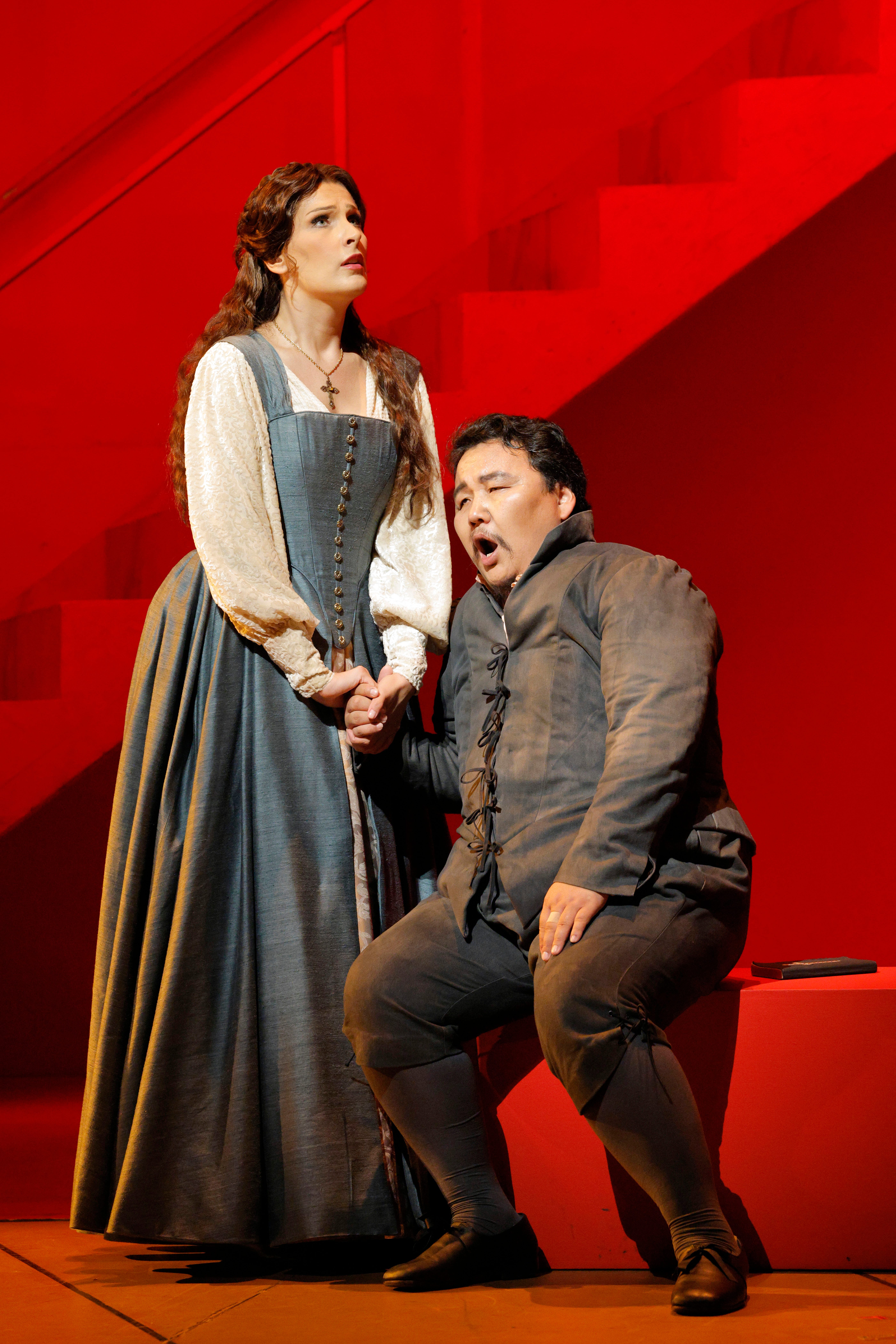
Adela Zaharia as Gilda and Amartuvshin Enkhbat as Rigoletto in the SF Opera’s production of Verdi’s Rigoletto. Photo by Cory Weaver/SF opera.
The top dog is a creepy, sexist vulgarian who boasts that he can grab women by the pussy and get away with it because he’s El Jefe. This sociopathic narcissist is surrounded by a sycophantic cabinet composed of second-tier sexual vulgarians who vie with their leader in rapey-ness and all-around nastiness. But even these incompetent, arrogant lickspittles can’t match the odiousness of Mr. Big’s jester, confidante, procurer and head suckup, a malicious little sadist who delights in tormenting his boss’s courtiers.
Sound familiar? You must be a Verdi fan! For this is pretty much an exact description of the Duke of Mantua and his court in Rigoletto, Giuseppi Verdi’s 1851 opera that opened the San Francisco Opera’s 103rd season last night. OK, the Duke of Mantua doesn’t actually boast that he can grab women by the pussy with impunity, and his sycophantic courtiers are not technically cabinet members, but those are mere details. In all important regards, the Dukedom of Mantua IS the Trump administration in 2025.
Watching the opera’s fine production of Rigoletto last night, I really, really wished it had been staged in Trump World. A Duke with orange hair and a predilection for conveying his sexual requests to his courtiers in tweets ending with the words, “THANK YOU FOR YOUR ATTENTION TO THIS MATTER!” would have made the liberal Verdi cackle from his grave with glee, not to mention thrilling the ghost of the radical republican Victor Hugo, whose Trumply-titled play L’Roi s’amuse (The King Amuses Himself), which inspired Rigoletto, was closed by the unamused authorities after just one performance. I am not privy to the political affiliations of the San Francisco Opera’s donor class, but any losses resulting from enraged MAGA poobahs would have been more than made up for by the national and international publicity that would have ensued. And the opera could have earned the eternal goodwill of the overwhelming majority of San Franciscans (only 15 percent of whom voted for Trump) by asking audience members to vote on what nauseating administration hack should be represented by the abhorrent jester Rigoletto. I and the friend with whom I saw the show had fun kicking around a few candidates—RFK, Jr.? Pete Hegseth? Kristi Noem? Kash Patel? Steven Cheung? All were solid options. But when I woke up this morning, I realized there was only one possible choice: Laura Loomer!
All these factors call out for an orange-hued production of Rigoletto. But against them must be weighed the very real possibility that President Trump, whose love for San Francisco is well known, would declare the SF Opera a terrorist organization and send U.S. troops charging up the steps of the War Memorial Opera House. So the opera gets a pass this time, but in 2032 or whenever the next production is staged, it must be Trumpoletto! Thank you for your attention to this matter!
Despite lacking Trumpiness, this production of Rigoletto was very good. As the title character, Mongolian baritone Amartuvshin Enkhbat delivered a powerhouse performance in one of opera’s great thunderous lower-register roles, and also managed to convey his deeply flawed character’s humanity, which is expressed only through his love (albeit an extremely twisted and controlling one) of his daughter Gilda. Romanian soprano Adela Zaharia was also first-rate, combining agility and suppleness with a richer and more liquid tone than some coloraturas possess; her acting was also very impressive. Tenor Yongzhao Yu, as the sexual predator Duke, sang adequately, although he lacked the outstanding vocal attributes of his two co-stars, and acted his unpleasant role well. As always, the orchestra under Eun Sun Kim’s baton sounded marvelous. And Michael Yeargan’s de Chirico-inspired sets, halfway between pittura metafisica and Italian neo-realism, added a suitably uncanny and ominous atmosphere.
So it was a mostly excellent production, with some lovely musical moments—in particular the duets between Rigoletto and Gilda, and the quartet in the final act between the Duke and his latest sexual target Maddalena, and Rigoletto and Gilda. Yet I confess the whole thing left me a bit unmoved.
The problem is the story. The very things that make Rigoletto so weirdly and distastefully similar to Trump World—its egregious male chauvinism and world-class sexism, including a blasé attitude to the Duke’s seduction/rape of Gilda, which takes place under false pretenses and is consummated in seven minutes — also diminish its artistic power. The biggest problem is Gilda. As written, she’s entirely a creation of male fantasies, desires and needs—and that includes not just the yucky men in the opera, but the men who wrote the opera. The fact that at the opera’s climax she continues to love the Duke enough to make the ultimate sacrifice for him, even though she has just learned that he is a total philandering asshole and has only known him for about nine minutes total (seven minutes of which were the seduction/rape) makes it hard to see her as anything except a two-dimensional narrative placeholder. Which makes it hard to feel anything for her. When the Duke sings “La donna e mobile,” one of the most famous arias in all of opera and a veritable ur-document of sexism, it’s supposed to shine a light on his misogynistic beliefs, but based on the evidence of the work at hand, it could easily reflect those of Rigoletto’s creators as well. Although the problem with Gilda isn’t that she’s fickle, but that she’s loyal to the point of idiocy.
Of course, Rigoletto is hardly alone in having a major implausibility at its heart. Operas are notoriously implausible, on many levels—psychological, practical, spiritual, you name it. Willing suspension of disbelief is as essential a thing to bring to an opera as opera glasses. And most of the time, I’m able to suspend my disbelief with the best of them. I’m not sure why I wasn’t able to in this case. Lots of opera lovers who know opera far better than I do, and presumably aren’t any more chauvinist or sexist than I am, adore Rigoletto: In A Night at the Opera, Sir Denis Forman’s irreverent guide to the great operas, he writes, “The plot, though corny, is bullet-proof.” To me, it’s as riddled as The Godfather’s Sonny Corleone after Barzini’s hit-men block his car at the toll plaza and open fire on him with machine guns. Go figure.
One last related peculiar aesthetic point. There is something extremely weird and jarring about both the words and music in the Duke’s impassioned aria about how he really, really loves Gilda, how she was awakened in him a desire to be a better man, how love alone takes us close to the angels, etc.—an aria being sung, of course, by a terminal, morally bankrupt seducer. This strange double reality is actually one of the most interesting moments in the opera. The Duke kind of seems to believe what he’s saying, but it’s also his, uh, hormones talking. Verdi and librettist Francesco Piave obviously know both things, but they don’t undercut him by adding anything subversive or self-ironizing in the lyrics—he could be any conventional operatic male lover declaiming to the heavens. Making things even more aesthetically and ethically ambiguous is Verdi’s glorious music, which overpowers the words anyway and implicitly supports the idea that love really has sprung up in the Duke’s nonexistent heart. I don’t know enough about opera or classical music to know if Verdi or any composer at the time had either the technical tools or the desire to write music that would undercut the ostensible sincerity of such an aria. I suspect they had the tools but not the desire, which makes the effect of the aria even harder to read: Soaring, conventionally beautiful music accompanying the self-serving, self-deceiving words of a corrupt Don Juan. Is this conventional beauty intentional—which could mean Verdi is consciously exemplifying and amplifying this moment of hormone-driven male self-deception? There would then be a very subtle irony lurking behind the aria. Or is Verdi just plugging in a pretty melody because it fits the lyrics and that’s how he works? That seems more likely, but it’s a less satisfying artistic move, because it means there are aesthetic and moral dissonances in the work that Verdi is not aware of and/or not in control of. We’ll never know, but it’s an interesting conundrum, and one that you don’t come across every day—yet another thing to explore in the endlessly fascinating universe of opera.
Rigoletto runs on Sept. 10, 13, 16, 19, 21, 24 and 27, 2025. For tickets and more information, click here.
Hi Marissa, thanks for your note. That sounds like a really interesting and timely project, and I hope you can present it through the SF Opera as part of their educational programming. I love your new title, too--and good for the Opera for letting you use it!
And thanks, Professor Smart, for your informed and insightful note. I'm gratified that someone of your standing agreed with much of what I wrote. You make a good point that perhaps Hugo is more guilty of misogyny than Verdi or Piave. And your comments on the possible reasons for the anomalous sincerity of the Duke's aria are really illuminating. Thanks again for writing!
I really enjoyed this post. I agree with most of what you say about the current SF staging and the opera itself. Of course it's not quite true that Gilda has known the Duke for only 9 minutes, counting the (offstage and undescribed) seduction/rape. They have a full-scale duet together in the first act, plus all those glances exchanged in church--so that adds at least another 7 or 8 minutes to their relationship, not insignificant if you're measuring it in opera-time.
For me the irrationality of Gilda's self-sacrifice at the end and the incongruous beauty of the Duke's lyrical outpouring at the beginning of Act 2 make the opera endlessly interesting to think about. I don't think Gilda's behavior can be entirely put down to the misogyny of the opera's creators. (If anything, Hugo would be more culpable there than either Verdi or Piave.) The strong stereotype of the virginal and redemptive heroine in 19th-century culture is certainly part of it (think Senta in the Flying Dutchman). But maybe part of the story is also the way Gilda has been cooped up and insulated from any experience of normal social interaction or even family, beyond her claustrophobic relationship with her father.
On the anomalous sensitivity of the Duke in "Parmi veder le lagrime," I share your perplexity. It's not just about writing a pretty melody to fit the lyrics, because Verdi regularly sent his librettists back to the drawing board to rewrite lyrics that didn't fit the mood he wanted for a character. And he certainly did have command of techniques that would allow him to write music that comments ironically on a plot situation. Arguably he does this in the first scene of Rigoletto through the tinny, forced character of the dance tunes played by the orchestra, and also through the swagger and mindless repetition of the other music he gives the Duke to sing. It's possible that he wanted to suggest that the Duke could fleetingly feel real love, but I think it's more likely that the form of the aria dictated that the Duke would sing something heartfelt here. By convention (and sometimes even by contract) the lead tenor had to be given at least one extended ("double") aria with a slow lyrical section followed by a flashy cabaletta, and the genre of that first lyrical section maybe required a style of melody that can only sound sincere and appealing.