
A coach for all seasons
Golden State Warriors coach Steve Kerr epitomizes everything that’s best about the Bay Area.

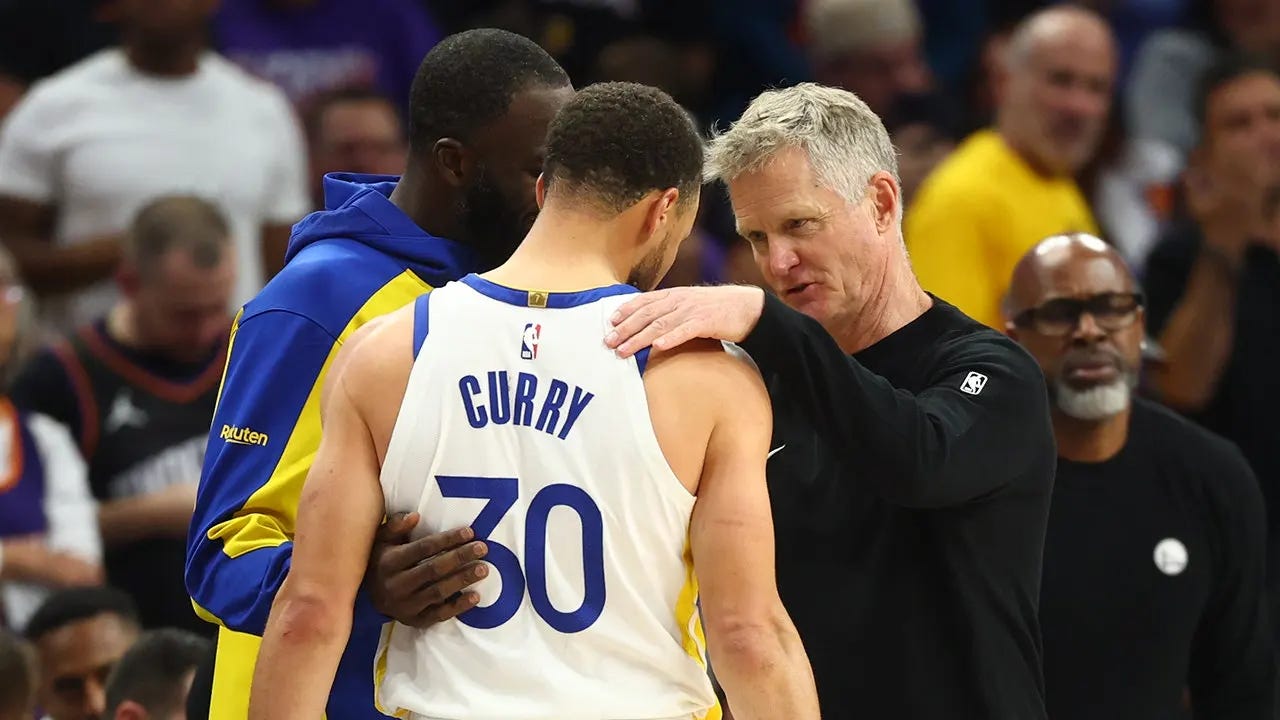
Golden State Warriors coach Steve Kerr expresses his love and appreciation to Steph Curry and Draymond Green in the waning moments of the Warriors’ loss to the Phoenix Suns, which eliminated the team from the playoffs. At this moment, Kerr did not know whether he would return to coach the team.
The news is terrible these days. We have an egregiously unfit president waging a ruinous war only he was stupid enough to launch, a close ally engaging in a 21st century version of California’s genocidal 19th-century Indian wars, a proposed “National Garden of American Heroes” that refuses to say that Martin Luther King was fighting against racism, a cabinet of lickspittles who make the attendees of the tea party in Alice in Wonderland look like the 12 Wise Men of the East, a circular firing squad masquerading as the Democratic gubernatorial race, and so on. Good times!
But there is a ray of light: The Golden State Warriors re-signed Steve Kerr.
For the next two years, Warrior fans—and non-basketball fans smart enough to pay attention when a singularly wise, kind, funny, humble, tough, and empathetic person pops up in public life—will once again get to enjoy Steve Kerr, in what will likely be his last hurrah as coach of the Warriors. And we will enjoy him not just as a great coach, but as something even rarer: a man who epitomizes all of our region’s best qualities—the ones we’re proudest of, and the ones most uniquely associated with us. Kerr may or may not be the greatest coach in Bay Area history—the consensus seems to be that he’s slightly behind former 49ers’ coach Bill Walsh—but he is the one who best reflects our values. As a coach and as a man—the two cannot be separated—he is who we aspire to be, and who at our best we are.
Coaching is a unique, and uniquely challenging, profession. I’ve never coached, but I have worked as an editor for most of my career, and there are some striking similarities between the two undertakings. In a 2007 Salon essay in praise of editors, I wrote, “Editors are craftsmen, ghosts, psychiatrists, bullies, sparring partners, experts, enablers, ignoramuses, translators, writers, goalies, friends, foremen, wimps, ditch diggers, mind readers, coaches, bomb throwers, muses and spittoons — sometimes all while working on the same piece.” This pretty much describes any given interaction Kerr ever had with Draymond Green. As that comparison suggests, coaches and editors both must possess not just technical skill, mastery of the xs and os of their respective crafts, but people skills. Just as every athlete is unique, so is every writer. With some, a taste of the lash is required; with others, merely a raised eyebrow will do the trick. One size definitely does not fit all. EQ is as important as IQ.
During his 12-year tenure with the Warriors, Kerr has shown that his EQ is off the charts, up there in rarified Esther Perel/Nelson Mandela territory. Managing the fiery, and frankly often impossible, Draymond alone qualifies him for the Coaching Hall of Fame, not to mention several honorary doctorates in counseling and family therapy. But Kerr has also dealt with a host of other challenging personnel issues, from the unfortunate Jonathan Kuminga standoff to the tricky post-punch Jordan Poole situation to whatever was going on with Andrew Wiggins to managing such colossal talents, and egos, as Klay Thompson and Kevin Durant, and he’s handled them all with tact, grace and generosity. Coaching is also a lot like parenting—yes, some professional athletes are grown-ass men, but others are closer to half-assed boys—and watching Kerr navigate dealing with the varied personalities and maturity levels of his players is like watching a master class in being a dad. He’s empathetic but firm, flexible and self-deprecating without giving up his authority, and above all, funny as hell. (One of Kerr’s coaching mentors, the great Gregg Popovich, was also very funny, but he could be mean and scary, his wit too dry and biting, his contempt for the formulaic halftime questions served up by hapless courtside reporters too obvious. Kerr has Popovich’s dry wit, but has a twinkle in his eye that the legendary Spurs coach often lacked.) In an area that prides itself, sometimes to the point of insufferability, on being highly evolved, Kerr is a model of self-awareness and psychological sensitivity.
But at the end of the day, everything a coach does is in the service of one overarching goal: winning. That’s all that matters. And that’s true for Kerr—except that it’s not.
Kerr is a winner. His Warriors have won four titles. The 2015-16 team went a ridiculous 73-9, a record that will probably never be broken. He has the fourth-highest winning percentage among coaches with at least 900 games, and his playoff winning percentage ranks third. He’s delivered on what Warriors majority owner Joe Lacob hired him to do, and what long-suffering Warrior fans had been waiting for since Al Attles’ Rick Barry-led squad won it all in 1975. If those four championship banners were not hanging from the rafters of the Chase Center, we probably wouldn’t even be talking about Kerr right now. But perhaps the most unusual and admirable thing about Kerr is that in a win-or-else league and a win-or-else culture, he openly accepts the possibility, and in some cases the likelihood, of defeat. He’s a realist who has not attempted to deny that the Warriors are, as he said, “a fading dynasty.” And he has made his peace with that. From the very beginning of his tenure with the Warriors, Kerr has insisted that it’s all about the journey. Winning can be part of that journey—and if you have a skinny kid from Davidson named Wardell Stephen Curry on your team, there’s a much better chance it will be—but so can losing. Kerr not only accepts this truth, he embraces it. In fact, it is an integral part of his coaching philosophy.
That philosophy has four components: joy, mindfulness, compassion, and competition. The last quality needs no explanation. But the first three are a little unusual. They’re not words that are used a lot in the world of sports—with the notable exception of former Chicago Bulls coach Phil Jackson, another one of Kerr’s mentors, who incorporated a Zen mindfulness into his coaching practice. They seem too woo-woo-y, too personal-growth-y. But as Kerr uses them, they’re far from New Age pablum. In a long, brilliant profile for ESPN, Wright Thompson recounts how Kerr’s life has been marked by personal tragedy as well as competitive triumph, by agonizing physical pain as well as great worldly success, by recurring self-doubt as well as hard-earned confidence. Those experiences made Kerr who he is, and they’re all reflected in his coaching philosophy.
Kerr’s players respond to that philosophy because it’s real, and because he’s real. And also because, well, it works. Kerr’s peace-love-and-understanding credo may sound gauzy or sentimental, but it is just as hard-headed, and ultimately probably more effective, than the most ferocious win-or-else Vince Lombardi-style tirade. Kerr demands the best of his players, he won’t tolerate lack of effort or preparation. But he also knows that athletes, like all of us, give their best when they’re happy, when they’ve tapped into the most authentic part of themselves, when they understand that there are bigger things in life than sports, and when they care about their teammates as much as they do about themselves.
By a happy coincidence—or maybe it’s not a coincidence—Kerr’s selfless philosophy is reflected in the kind of basketball the Warriors play, with its nonstop movement, a hardwood version of soccer’s jogo bonito—“the beautiful game.” The Warriors’ jogo bonito has been not only some of the most aesthetically pleasing basketball ever played, it’s been some of the most successful. But it’s Kerr’s embracing of the journey, whether that journey ends in victory or defeat, that really sets him and his approach apart. “I think it’s the attempt when you’re in it that is the most important thing,” Kerr said in 2025. “Obviously, we all know rings culture. We all focus on who won. But there is something beautiful in the fight, in the quest. And because we love it so much, because we love what we do, there really is a beauty in the collaboration, the journey, the quest to hang in there and maybe reach the top of the mountain one more time. You just can’t quantify it. But we all know inside what that journey means to us.”
That is a very San Francisco vision. The openness to the journey, to experience for its own sake, is a leitmotif in the city’s history, most dramatically manifested in the mad event that gave birth to the “instant city” of San Francisco, the Gold Rush. We think of that frenzied stampede in 1849 as all about striking it rich—as “winning”—and for many 49ers that’s all it was. But for others, “seeing the elephant,” as the Argonauts called their experience in California, came to mean something different and deeper. They came to understand that whether they found gold or not, the journey out West had been the great adventure of their lives—and that adventure was its own reward. In Buddhist terms—and Kerr’s— theirs had been a mindful journey. They weren’t the first San Franciscans to realize this truth, and they would not be the last. From the Yelamu Indians who left a fragment of poetry that reads “Dancing on the brink of the world,” to the mavericks and dream-drugged escapists who in the 1830s washed up at a mixed-race hamlet at the end of the world, to the darkly ecstatic Beats, the rock-into-the-eternal-now hippies and the avant-garde urban explorers of today, this place has always danced to its own interior drummer. The sheer physical beauty of the Bay Area has also played a key role in this blown-out joyousness: as the fin de siècle writer Gelett Burgess wrote of his cottage on Russian Hill, with its spectacular view of the Bay, “For here Nature came to our very doorsteps and bade us to be of good cheer.” When he asks his team to play with joy, Kerr stands in a long and honorable Northern California tradition.
The other thing that makes Kerr the perfect coach for the Bay Area is his willingness to speak passionately out on political subjects, including ones few if any sports figures will take on. After the 2022 school shootings in Uvalde, Texas, when 19 fourth-grade students and two teachers were killed, Kerr exploded in rage and anguish. “When are we going to do something?” he yelled, slamming his fists on the table. “I’m tired. I am so tired of getting up here and offering condolences to the devastated families that are out there. I am so tired of the moments of silence. Enough!” It was a cathartic and wrenching moment of raw emotion, an eruption of unfiltered feelings all too rare in the cautious, homogenous world of billion-dollar sports franchises. Nor would many of his peers would have the cojones to call our current president a “buffoon,” as Kerr did.
And Kerr is willing to take on even more explosive subjects than gun control, or Donald Trump. In 2004, on a reporting trip to the Middle East, I stood on the campus of the American University of Beirut, where Kerr’s father, university president Malcolm Kerr, had been assassinated by Islamic Jihad terrorists 20 years earlier. When Kerr (who was born in Beirut) became coach, I remembered that moment, and inevitably wondered what his Middle East politics were. The answer became clear in a recent interview Kerr did with the New Yorker. Criticizing the U.S.-Israeli war on Iran and Israel’s destruction of Gaza, Kerr said, “Violence begets violence. We’ve seen it in Israel and Lebanon as well. There was an opening for Israel to handle their business with the Palestinians diplomatically that would have solidified the Abraham Accords and allowed stronger alliances with Arab countries that would have really cornered Iran. Instead, Israel sought revenge for October 7th and now seventy-two thousand Palestinians have been killed and Israeli settlers are taking over the West Bank illegally, with the approval of Israel’s government and the U.S. Ambassador, Mike Huckabee. That’s not a path to any sort of peace or security for Israel or the rest of the Middle East.”
It’s worth noting the sophistication, and courage, of Kerr’s comment about Gaza. He did not even bother to engage with the absurd official line that Israel tried to minimize civilian casualties, instead stating the obvious fact that its genocidal onslaught was driven by revenge. Kerr’s willingness to speak out about Gaza is even more impressive in light of the fact that not a single coach of any major American sports team, and very few players, have done so. In an age when all too many sports figures have heeded Trump acolyte Laura Ingraham’s demand to “shut up and dribble,” Kerr’s views, and his outspokenness, fit right in with the most politically progressive region in the country. It makes sense that the Oakland Coliseum, where the Warriors won three of their four titles under Kerr, is a few Bart stops down the line from the place where the Free Speech Movement was born.
Kerr is not the only illustrious Bay Area coach who has reflected the region’s values, or been seen as doing so. Giants’ manager Dusty Baker was probably the hippest coach we’ve ever had around here: he played Miles Davis in his office, dug Jimi Hendrix, painted, and yes, appreciated a good Chardonnay. Dusty was a bad man, and deeply beloved, and if he hadn’t pulled Russ Ortiz out in the 7th inning in that infamous Game Six in 2002, we might be exalting him as our role model today. Bruce Bochy gave off a low-key blue-collar vibe that will always resonate in these parts. John Madden led teams of misfits and renegades to gridiron glory. And current 49ers coach Mike Shanahan has a lot of the same tough but sensitive qualities as Kerr.
Of all those memorable coaches, former 49ers coach Bill Walsh was the most interesting, and was most often presented as the perfect coach for the Bay Area. He was invariably characterized as “professorial” and “brainy,” qualities associated with the area’s world-class universities and a vague, pre-Internet sense of intelligence wafting up from the Peninsula. This view of Walsh and his team morphed into the slightly less positive claim that the 49ers were a “finesse” team (which they kind of were on offense, although running backs who were hit by the human baseball bat named Ronnie Lott might beg to differ), and that their fans were effete, Chardonnay-sipping quiche eaters (guilty as charged, although heavier on the Chardonnay than the quiche. I prefer a Spanish tortilla.) But if Walsh did reflect some deep Bay Area traits, he was ultimately too sui generis to represent anything but himself. “The Genius” was far more high-strung than Kerr: a maniacal perfectionist, he was so burned out that even before the end of his final season with the 49ers, which ended with the team winning its third championship, he decided to retire. After the Super Bowl, as the team celebrated in its raucous locker room, he sat alone and wept with his head in his hands. And yet, like Kerr, Walsh knew how to use humor to get his team to relax, famously pretending to be a bellhop as his players checked into their hotel before the 49ers’ first Super Bowl. In fact, Walsh played a key role in the creation of Kerr’s joy-based coaching philosophy: Kerr credits former Seahawks coach Pete Carroll with inspiring that philosophy, and Carroll told him he learned it from Bill Walsh. In that regard, Walsh is an almost tragic figure: he taught his players to play with joy, yet he himself was unable to savor his journey.
Kerr isn’t immune to the dark side of working in a profession in which every game presents an opportunity to lose. As Wright’s profile reveals, Kerr’s lows can be pretty low—he all but made up his mind to retire after this difficult season. But the fact that Kerr is no Buddhist saint, that he has all-too-human struggles but is able to rise above them, only adds to his appeal. He’s not a hero, he’s something we can all use a lot more of: a mensch.
As noted, the fact that Kerr’s Warriors have won four championships doesn’t hurt his standing. Everyone likes a winner, and championships give birth to a thousand overblown metaphorical comparisons, though few as brilliant and insightful as the one you’re reading. (I borrowed that joke from Kerr, who in turn stole it from an old San Francisco newspaperman named Mark Twain.) The front office, the coaching staff, and the Warriors players will do everything they can to win another title, and if they do it will be an amazing finish to this epic adventure. But as Kerr heads into what will likely be his final two seasons, I don’t think any Warriors’ fan will think that the Dubs need to win another title to make Kerr’s journey, or the team’s, or our own, complete. The fact that Kerr is coming back, and Steph Curry will be playing for him to the end, and maybe Draymond Green and new Warrior-in-our-hearts-forever Jimmy Butler as well, means we have already won. We’re playing with house money. We’ll enjoy the ride on the wheel of fortune until it stops turning, wherever that is—and we’ll enjoy it all the more because we know that Steve Kerr will be enjoying it, too. For Warrior fans, the next two years will be a kind of farewell tour, a lovely and elegiac chance to see the last incarnation of a fabled dynasty, a player the likes of which none of us will ever see again, and a coach who won both on and off the court—and did it his way. For a man who preaches the gospel of joy, it couldn’t end any other way.
A shorter version of this piece appears in the San Francisco Standard.
A big reason why we love the Warriors. And San Francisco. And reading Gary Kamiya.
Gary, a really fine piece. While I only "know" some of the players/coaches, it doesn't matter. The whole "it's the journey, not the destination" vibe reminds me of the philosophy of my own father. He squeezed every ounce of joy out of any experience while encouraging others to do the same. I grew up believing I could accomplish unimaginable challenges regardless the degree of difficulty, and if the result was not in my favor, despite the disappointment, I could take comfort in the fact that I had tried and learned many useful tips along the way. In retrospect, I can't remember anyone who did not like/respect/appreciate/enjoy being with him regardless of the circumstance or outcome.